
Information is Physical
Rolf Landauer vs Maxwell's Demon

I recently spent time drafting what I think is a reasonable case for a thermodynamically grounded framework that might explain the inevitable emergence of life, then consciousness, then morally grounded societies – all operating under the same basic conditions and constraints.
The lynchpin to the whole concept is an insight from an IBM researcher named Rolf Landauer in the late 1950s and early 60s.
Before I say what the insight was, I’ll try to describe what Landauer was trying to do and a little about how he landed where he did.
He had a concrete question and some follow ons:
as computers get smaller and faster, what are the fundamental physical constraints on how efficiently they can operate? Is there a floor below which computation cannot become more efficient, and if so, where does that floor come from?
The intuition at the time was that computation must inevitably generate heat - that there was something intrinsically dissipative about the act of computing. But the reasons for this were not well understood. People assumed it had something to do with the signals themselves, or with the switching of transistors, or with electrical resistance. All of which is true. But Landauer looked more carefully.
His big idea was to separate logically reversible operations from logically irreversible ones.
A logically reversible operation is one where you can always reconstruct the input from the output - no information is lost. A logically irreversible operation is one where you cannot - information is destroyed.
An example of a reversible operation is: If I tell you that I added 4 to a number and the result is 10, then I know that the number was 6. No information is lost in the calculation.
A logically irreversible operation loses information. Take an AND gate or function with the following conditions:
0 AND 0 = 0
0 AND 1 = 0
1 AND 0 = 0
1 AND 1 = 1
In that situation, three different inputs produce a 0 value. Given the output 0, you can’t definitively reconstruct the inputs. The information about the prior state is destroyed – eliminated from physical record.
The simplest logically irreversible operation is erasure. When you erase a bit - set it to zero regardless of whether it was zero or one - you lose the information about what it was. Two possible input states map to one output state. The operation cannot be run backward. Information has been destroyed.
Landauer’s insight was that this - logical irreversibility - is the source of unavoidable heat generation in computation. Not the electrical signals. Not the switching. The destruction of information itself. Every time a logically irreversible operation is performed, at minimum kT ln2 of energy must be dissipated as heat into the environment, where k is Boltzmann’s constant and T is the temperature. I need to be careful to acknowledge that the information erasure is NOT the only source of heat dissipated into the environment – the machine with its electricity and transistors play a role, too. But he derived the bare minimum amount of heat that must be dissipated for a bit of information lost.
And this became known as Landauer’s principle. It established for the first time that information is not abstract - it is physical. It is instantiated in physical states, and destroying those states has a thermodynamic cost that cannot be avoided regardless of how clever your engineering is.
The corollary is equally important: logically reversible computation need not dissipate heat. In principle a computer that never erases information - that runs all its operations reversibly - could compute without generating heat. In ways that I don’t understand yet, this led to the field of reversible computing, and later to connections with quantum computing, where reversibility is fundamental. It involves the Schrödinger equation (yes, he of the cat) and the fact that quantum mechanics are fully reversible. A topic to study up and write about in the future, I hope.
Back to Landauer and what he figured out.
In 1867, James Clerk Maxwell proposed a thought experiment. The second law of thermodynamics says that in a closed system, entropy never decreases. Heat flows from hot to cold and ordered states become disordered.
But, while this seemed to prove statistically true – always holding as true for large numbers of molecules, he wondered if a sufficiently clever and small entity – a tiny little demon – could observe and respond to individual molecules so that they broke the rule.
He came up with a thought experiment:
A gas-filled container divided by a partition with a small door. The demon watches molecules approach the door. When a fast molecule comes from the left, he opens the door — fast molecule passes to the right. When a slow molecule comes from the right, he opens the door — slow molecule passes to the left. He does this selectively, letting fast molecules accumulate on the right and slow molecules on the left.
Fast molecules are hot. Slow molecules are cold. Without apparently doing any work — just opening and closing a massless, frictionless door — the demon has created a temperature gradient. The right side is now hot, the left side cold. You could run a heat engine between them and extract useful work. Entropy has apparently decreased. The second law appears violated.
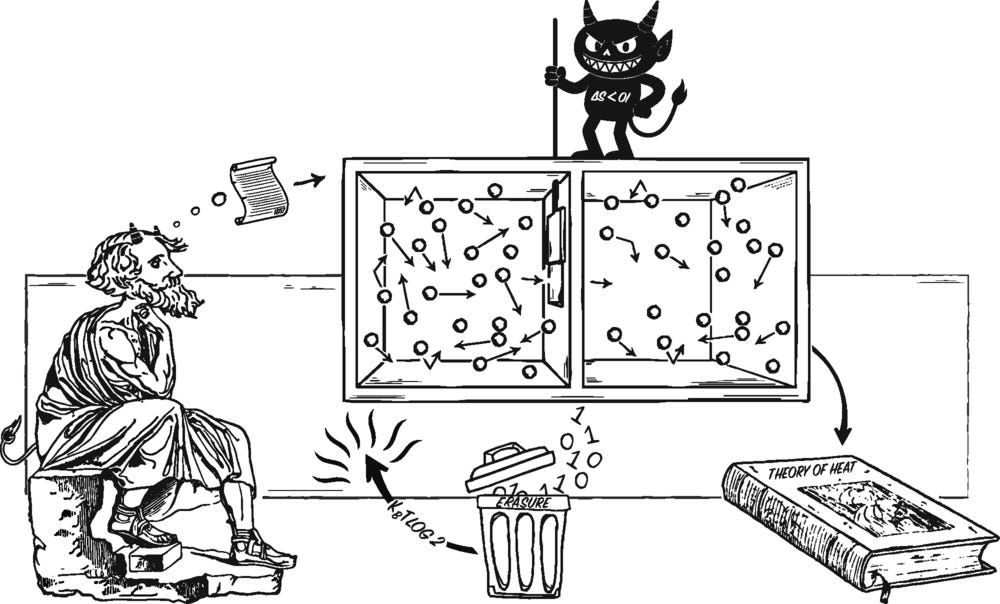
This experiment flummoxed physicists for a long time. In 1929, Leo Szilard realized and showed that the demon had to do some work. It would need to measure the speed of each molecule and that measurement has a cost, but he didn’t really define the cost.
Landauer’s contribution was to locate the thermodynamic cost precisely. It isn’t in the measurement. Instead it’s in the information erasure.
He said that the demon measures each molecule - fast or slow - and stores the result in his memory. Each measurement adds one bit to his memory. The demon’s memory is a physical system - it has to be, because the demon is a physical being operating in a physical world. Over time, as the demon sorts thousands and millions of molecules, his memory fills up.
At some point the demon must erase his memory to continue operating. He can’t store an infinite record of measurements. He has to wipe it and start fresh or at least erased one bit for every bit added.
And here’s where Landauer’s principle comes in. Erasing the demon’s memory is a logically irreversible operation. Each bit erased dissipates at minimum kT ln2 of heat into the environment. Over the course of sorting the gas, the total heat dissipated by erasing the demon’s memory exactly compensates - at minimum - the entropy decrease achieved by sorting the molecules.
The demon cannot cheat the second law because the demon’s memory is part of the physical system. The information stored in his memory is real, physical information, instantiated in real physical states. Destroying that information - erasing the record of measurements - costs exactly what thermodynamics requires.
This was fully worked out by Charles Bennett at IBM in 1982, building on Landauer’s foundation. Bennett showed that measurement itself need not be dissipative - you can measure reversibly. But erasure is always irreversible, always costly. The Maxwell’s Demon problem, which had resisted resolution for over a century, dissolved once information was recognized as physical.
The resolution carries a deep philosophical implication. The reason the demon cannot violate the second law is not because he lacks sufficient cleverness or speed. It is because he exists in the physical world. His memory is matter. Erasing it is a thermodynamic act. Information and physics are not separate domains - they are the same domain described at different levels. Information erasure costs more thermodynamically than information persistence.
Landauer’s principle was theoretically compelling but experimentally unconfirmed for fifty plus years. The minimum energy that he predicted would be dissipated per bit erased at room temperature is approximately 3 × 10⁻²¹ joules - an insanely small number – though most of us don’t really think in joules. Regardless, measuring such tiny energy dissipations requires extraordinary experimental precision. He described all of this in nice detail in Information is Physical in 1991 in Physics Today (hence the title of this post).
In 2012, Antoine Bérut, Artak Arakelyan, Artyom Petrosyan, Sergio Ciliberto, Raoul Dillenschneider, and Eric Lutz published a paper in Nature titled Experimental verification of Landauer’s principle linking information and thermodynamics.
Their system was beautifully simple. A single silica bead - about two micrometers in diameter - suspended in water and trapped in a double-well potential created by a focused laser beam. The two wells represent the two states of a single bit. The bead can sit in the left well or the right well. The water provides a thermal bath at known temperature T.
To force the bead into a definite known state regardless of which well it started in, they slowly tilted the potential landscape. They raised one well relative to the other, forcing the bead over the barrier between them and into the lower well. This is information erasure - two possible starting states mapped to one definite final state.
They measured the heat dissipated during this erasure process across thousands of repetitions, using the known statistics of Brownian motion to extract the thermodynamic quantities. The result: at erasure speeds slow enough to approach the measurable limit, the heat dissipated approached kT ln2. It was exactly as Landauer predicted. At faster erasure speeds the dissipation was higher, consistent with the irreversibility of the operation.
It was confirmation of the conceptual claim: that erasing information is a thermodynamic act, that the link between information and entropy is not a mathematical analogy but a physical identity.
What this means is that, while the universe charges a mandatory thermodynamic fee for information erasure, information stability has no mandatory floor. And that is the keystone premise to my thermodynamic ladder framework: life -> consciousness -> moral society.
I’ll continue to try to refine it and how I describe it here on my substack.
I hope you enjoyed learning a little bit about Rolf Landauer and Maxwell’s Demon.
Both articles are a good read. I missed the February - Structure Under Constraint - article. Glad you linked it.
Your thermodynamic ladder explains how structure can exist under constraint, but it presupposes a unit that persists long enough to pay those costs. Thermodynamics gives you dissipation and metastability; it doesn’t give you boundary-maintaining systems. What selects for configurations that fund their own invariants rather than dissipating?