
Rolas Bravas
When the turtle doves showed me my mom

My mother was always up before anyone and in bed after all of us. There was never a meal she didn’t prepare, never a dish she didn’t wash by hand, never an article of our clothing she didn’t launder herself. She mowed the lawn in summers, raked leaves in fall, shoveled snow in winter. She handled the grind. All of it. Always.
My father was away for work eight or nine months of every year. Three children. One house. Nothing was for her. Nothing was about her. If she had wants of her own, she kept them somewhere none of us could see.
Then one year, the rolas came.
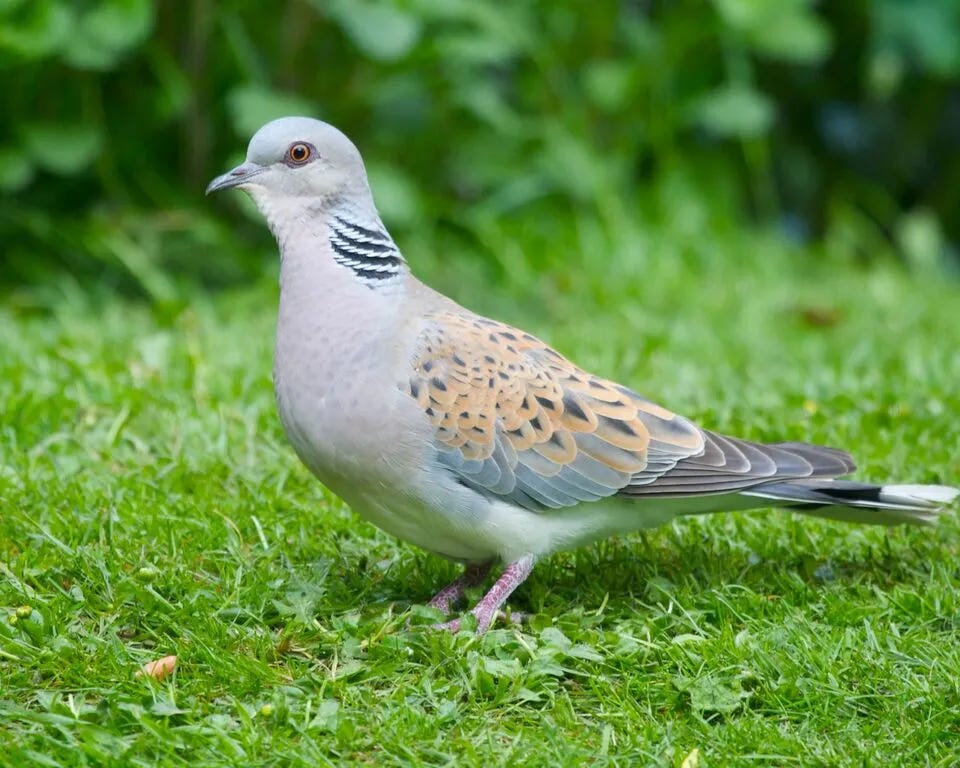
Turtle doves - a few of them, maybe three or four. They appeared in the yard. When my mother saw them, something shifted in her face. Something I had not seen before. Her brown eyes went bright. Her eyebrows lifted with excitement. She tore up Wonder Bread and scattered it on the driveway to coax them closer, and she watched them with a quality of attention she didn’t give to much else.
She called them rolas - a Portuguese word. Her pronunciation sounded like “hoh-laj” to my ten-year-old American ears. Sometimes she said the whole term: rolas bravas. Wild turtle doves. They were ordinary gray birds to me, barely distinguishable from the pigeons that lined our gutters save for interesting stripes on their necks. But to my mother they were something else entirely - visitors from her northern Portugal, from a life she had left behind. They were reminder she had every intention of holding onto.
Literally.
She announced her mission with complete seriousness, nodding as she assured us in Portuguese: “Vou apanhar uma dessas rolas.”
I will catch one of those turtle doves.
The morning of the attempt, I was standing by the breezeway door - the door we always used - watching.
My mother had scattered bread bits across the driveway and the rolas had assembled. So had the sparrows, which annoyed her. She wanted the doves. She crouched a few feet off to the side, very still, waiting.
Then she moved.
She accelerated into an awkward stooped sprint - like a football player lunging for a bouncing loose ball, but without a single athletic bone in her body. She reached down mid-stride, hands closing around one of the doves.
For a half second she almost had it.
Then the bird was gone. All the birds were gone - the doves, the sparrows, everything - scattering into the air at once in a brief panicked flutter, leaving the driveway suddenly empty and very quiet.
My mother straightened up.
In her right hand: a few feathers.
My father, who had been there as well, told her the attempt had been silly. But he used the word “stupid.”
She didn’t try again.
I had never seen anything like this from my mother. From either of my parents, really. Her enthusiasm had been childlike - the same quality I recognized from my own wanting, the way I felt about a new Transformer or a G.I. Joe. Pure and uncomplicated and completely hers.
She thought she had nothing to show for the effort. A few feathers in her right hand. Her husband’s contempt. One failed lunge at a bird that was already gone.
She didn’t know what her son had seen.
She had become more than my mother. She had become a person like me - someone with passion and wants that had nothing to do with anyone else’s needs. She had agency beyond her duties. She was, for the first time, three-dimensional and in color.
She never knew. I never told her.
I’ve had thirty plus years to find the words. Maybe these are them.
Yep, you found them, and full of wonder and tenderness.